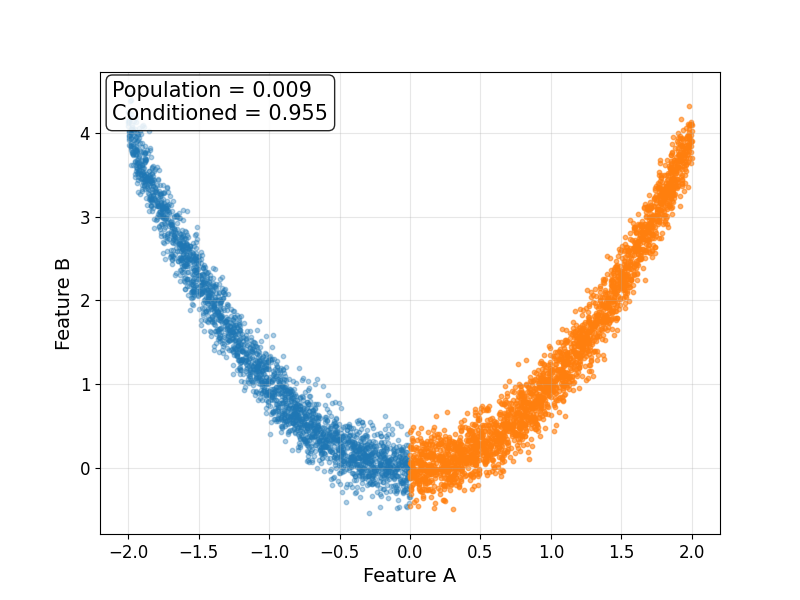
We give a concrete example; let $Y = X^2,$ where $X \sim \mathcal{N}(0,1)$. In the full population,
$$ \mathrm{Cov}(X,Y) = \mathrm{Cov}(X,X^2) = \mathbb{E}[X^3] - \mathbb{E}[X]\mathbb{E}[X^2] = 0, $$ because all odd moments of a standard normal vanish. Now condition on the event $X>0$. Then the conditional density is $$ f_{X \mid X>0}(x) = \frac{f_X(x)}{\mathbb{P}(X>0)} = \sqrt{\frac{2}{\pi}} e^{-x^2/2}, \qquad x>0. $$ Hence $$ \mathbb{E}[X^p \mid X>0] = \sqrt{\frac{2}{\pi}}\int_0^\infty x^p e^{-x^2/2},dx. $$
In particular, $$ \mathbb{E}[X \mid X>0] = \sqrt{\frac{2}{\pi}}, \quad \mathbb{E}[X^2 \mid X>0] = 1, \quad \mathbb{E}[X^3 \mid X>0] = 2\sqrt{\frac{2}{\pi}}. $$
Therefore, $$ \begin{align*} \mathrm{Cov}(X,X^2 \mid X>0) &= \mathbb{E}[X^3 \mid X>0]- \mathbb{E}[X \mid X>0]\mathbb{E}[X^2 \mid X>0] \\ &= 2\sqrt{\frac{2}{\pi}} - \sqrt{\frac{2}{\pi}}=\sqrt{\frac{2}{\pi}}> 0. \end{align*} $$